


Ready to jump into the technical details? Read the technical report (PDF)
We are excited to announce Anacreon, a new kind of human simulation model which achieves state-of-the-art accuracy at predicting individuals’ answers to new questions.
Existing methods of predicting populations are accurate at the aggregate level but break down at the level of the individual. Further problems persist around prompt brittleness and bias, making answers inconsistent across differently-worded questions and skewing results towards the preferences of majority groups.
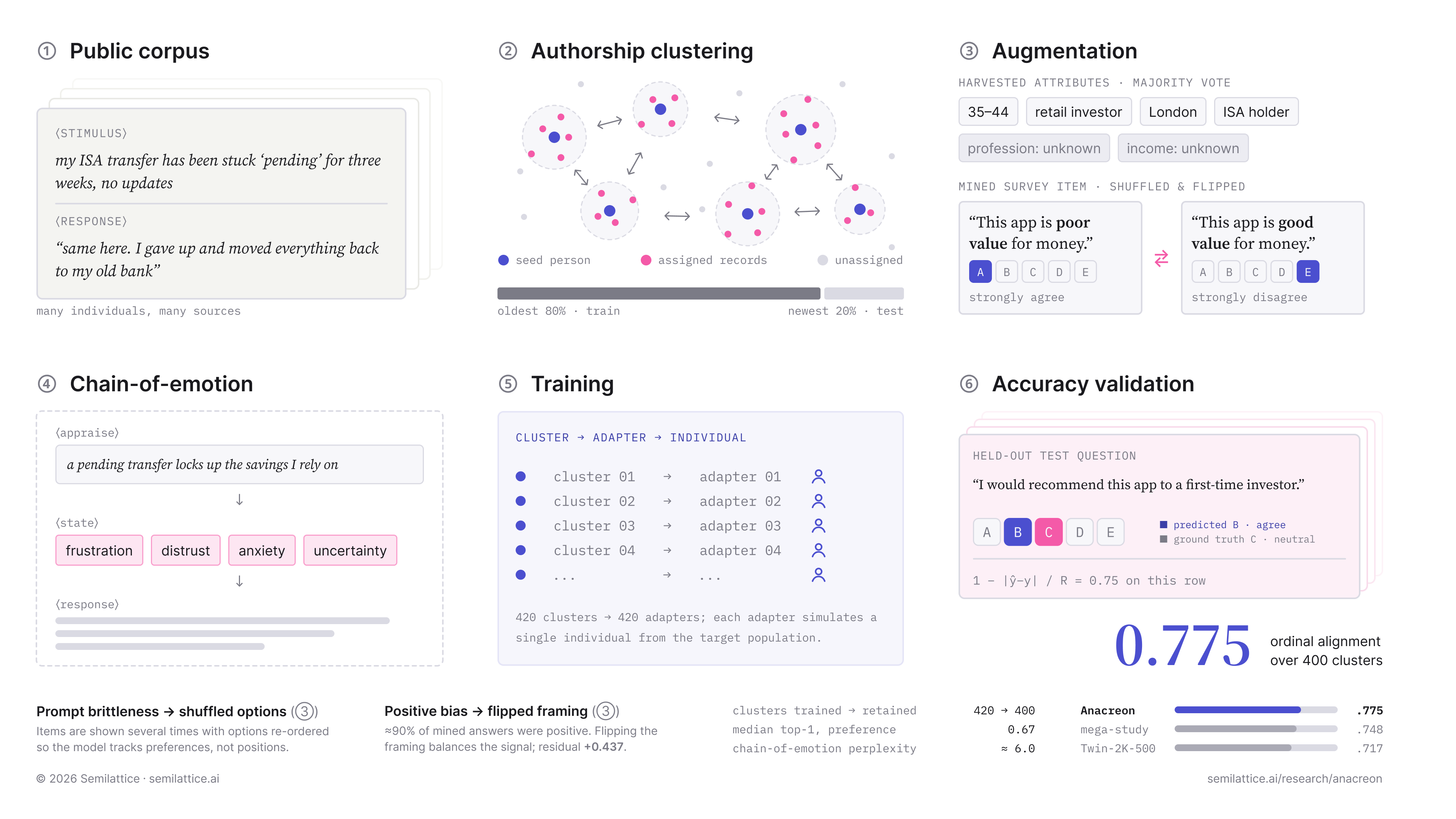
Anacreon solves these problems by focusing on the individual:
- A large corpus of human behavioural and attitudinal data is arranged into stimulus, response pairs
- Those data are clustered around a target set of seed people, attributes are mined for those people, and each cluster is then split into test and train sets
- Survey style questions are then mined, shuffled, and sentiment-reversed before chain-of-emotion traces are added
- Dedicated rank-64 QLoRA adapters are trained on a Gemma 4 12B base for each cluster, each modelling a single individual in the target population
The result is a mixture of minds model of models—a population of hundreds of distinct LLMs which each represent different people in the original target population.
On person-specific sets of held-out test questions, Anacreon achieves a state-of-the-art ordinal alignment of 0.775, the individual-level accuracy measure on which the field has converged.
Read the technical report (PDF) to learn more.
Cite the paper:
@techreport{dahiya2026anacreon,
  title       = {{Mind the Gaps: Mixture-of-Minds for Human Simulation}},
  author      = {Dahiya, Pranav},
  institution = {Semilattice},
  type        = {Technical Report},
  year        = {2026},
}