


Every product decision in consumer finance is a "what if." What if we move this feature behind the paywall? What if we lead with security instead of convenience? What if younger users love this but older homeowners don't care? Semilattice simulates how the people that matter to you would respond, using real research data, and returns predictions in minutes. Enough signal to act on, share with stakeholders, or kill a bad idea early.
But here's the thing about consumer finance: the people that matter to you aren't one group.
Your users are living different financial lives
A 28-year-old renter building an emergency fund and a 55-year-old homeowner growing a retirement portfolio aren't just different demographics. They have different anxieties, different priorities, and different reactions to the same product decision. The same pricing change that feels like good value to one feels like a cost to cut for the other.
Most product teams know this intuitively. But knowing it and being able to act on it are different things. In practice, you make one decision and hope it works for most people. You might run one survey with one broad sample and treat the average as the answer. The segments that disagree get averaged out. Their objections don't surface until after launch, if they surface at all.
Audience simulation changes this. When you can ask any question of a simulated audience in minutes, you can also ask that same question of multiple audiences. The same "what if" tested against different groups. Not just "how do our users feel about this" but "how do these users feel about this, and do those users feel differently?" That's one of the most powerful things about having fast, accurate audience models: the ability to validate a decision across segments before committing to it, and to see where consensus breaks down.
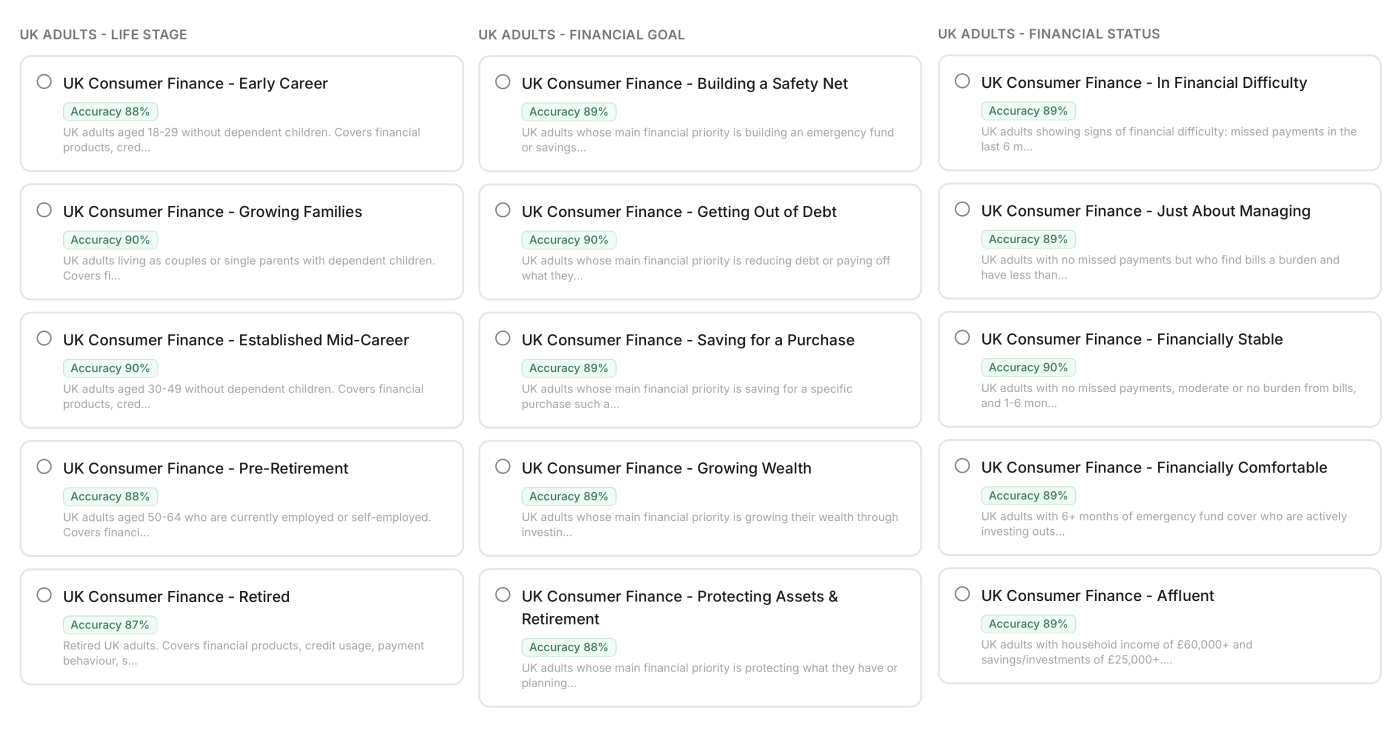
16 UK Consumer Finance audiences, from Growing Families to Just About Managing
Today we're launching 16 UK Consumer Finance audience models in Semilattice. One broad model, built on survey data from UK adults sourced through a high-quality panel provider, that mirrors most fintechs' overall user base. And 15 drill-down segments that let you ask the same question to different slices of financial life.
The segments cover three dimensions that shape how people relate to money. By household stage: Growing Families, Established Households, Pre-Retirement, and others. By financial position: Financially Comfortable through to Just About Managing. And by financial priority: Growing Wealth versus Building a Safety Net.
The differences between these groups aren't abstract. In our survey data, 73% of outright homeowners report having six or more months of emergency savings. Among private renters, that figure is 18%. A question about savings features, risk appetite, or subscription pricing will get fundamentally different answers from these two groups. Semilattice lets you see both answers, side by side, in minutes.
Built on real data, tested for accuracy
Every Semilattice audience model is built on real human survey data, not synthetic personas or LLM-generated profiles. The more that data matches the topics you're asking about, the better the predictions. That's why we built these models with finance-specific questions spanning financial confidence, savings behaviour, credit usage, banking preferences, and attitudes to financial products.
Accuracy across all 16 models ranges from 87% to 90%.
What is your own annual income from all sources (including benefits) before tax?
Accuracy: 97.0%
Explore what your segments think
If you're a PM in consumer finance, these audiences are ready to answer your questions. Ask all 16 the same question and compare. Drill into a single segment and explore it deeply. Test whether a decision that polls well overall falls apart for