


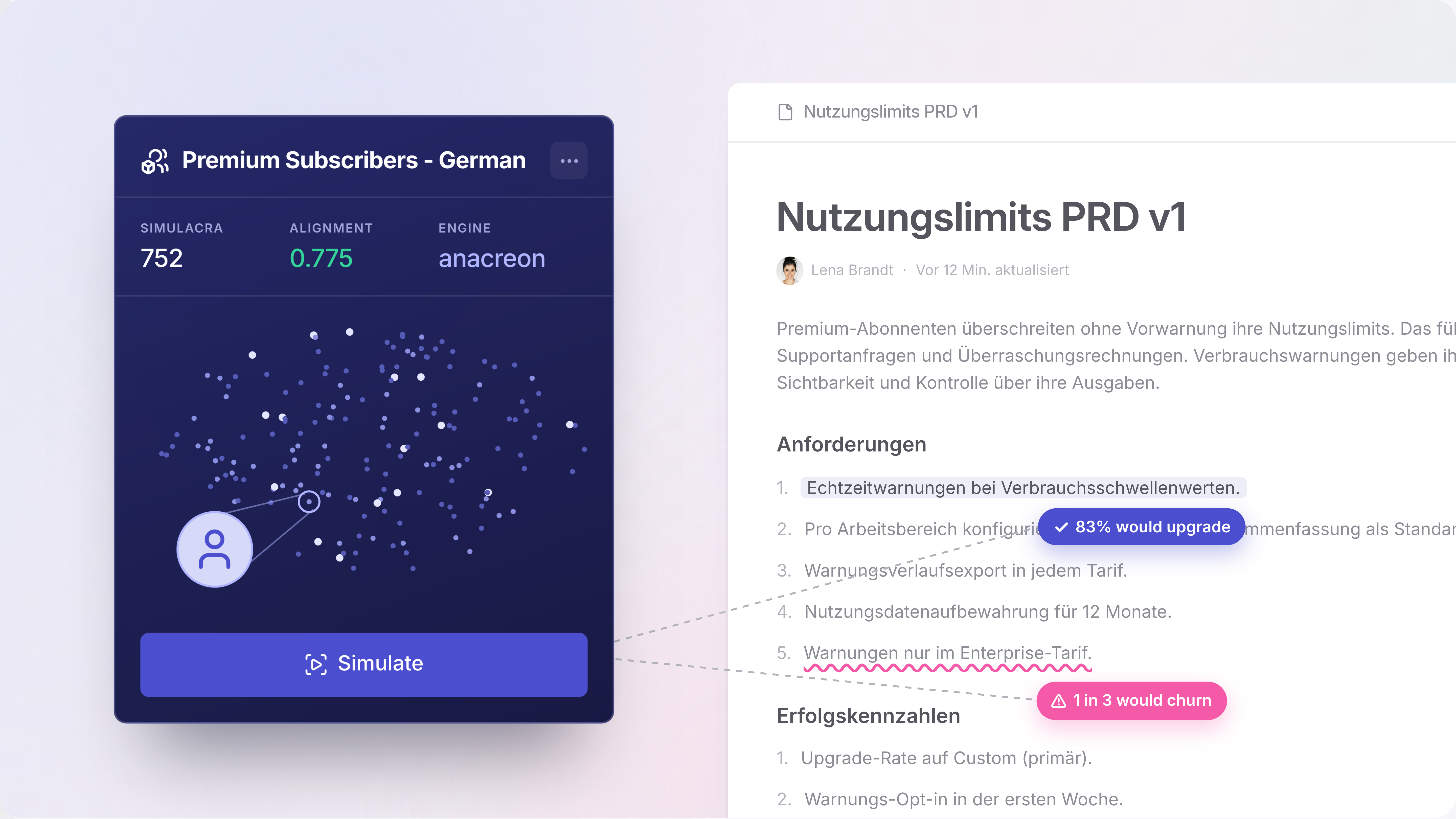
On July 30th, we announced Anacreon: our new human simulation model which achieves state-of-the-art accuracy in predicting individuals' answers to new questions. Read the announcement to learn more.
Until now, every user model we built spoke English. If your users are in Berlin or Madrid, that left you asking them in a language they don't use, or not asking them at all. Today we can build a model of people who speak another language and put your questions to them in that language.
This post explains how a non-English model is built and validated, what your simulated users are asked, and how you read the plan, the results and the recommendations if you don't speak the language yourself.
Built from data in the language, validated the same way
A model of German speakers is built from German data. The interviews, reviews, forum threads and open-ended survey answers behind it are the words real German speakers wrote, not English data with the labels changed.
It's validated the same way as an English model. We hold back a set of real answers from the data the model is built on, ask the model to predict them, and compare the predictions to what those individuals actually said. Every custom model ships with its own accuracy report, so you know how much to trust it before you run your first simulation.
Your users are asked in their own language
When you plan a set of questions for a non-English model, each one is written in the model's language and in English at the same time. The original is written the way a native speaker would ask it, not translated word for word from the English. A German agreement scale doesn't run from "Strongly agree" to "Strongly disagree" rendered into German. It runs from "Stimme voll und ganz zu" to "Stimme überhaupt nicht zu", which is what a German survey would actually use.
Your simulated users see only the original. The English is there for you.
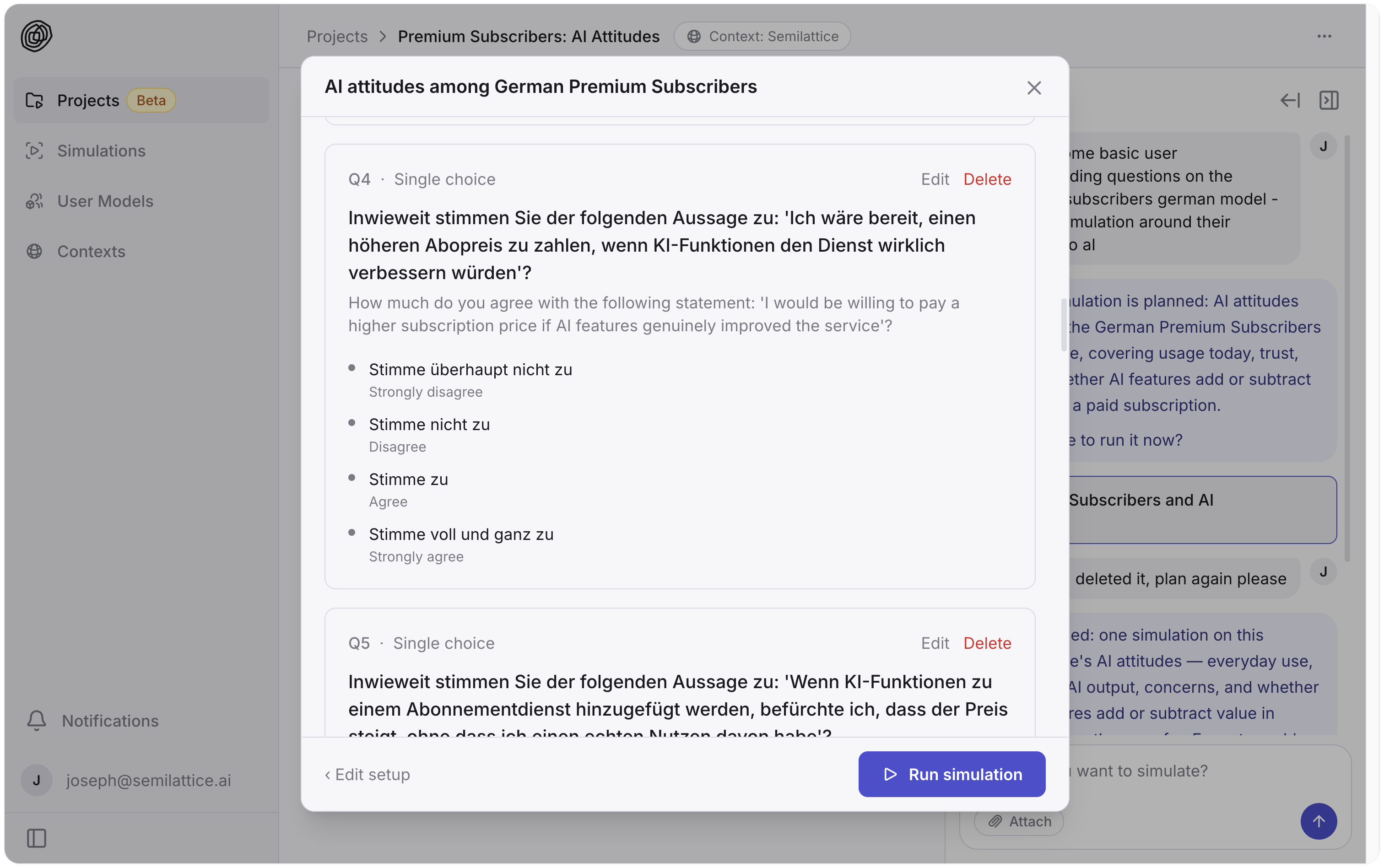
To change a question, edit the original wording, because that's the version your users are asked. The English is translated from it when you save. If that translation fails, the edit isn't saved, so you never end up reading an English question that doesn't match the German one.
Read the results in both languages
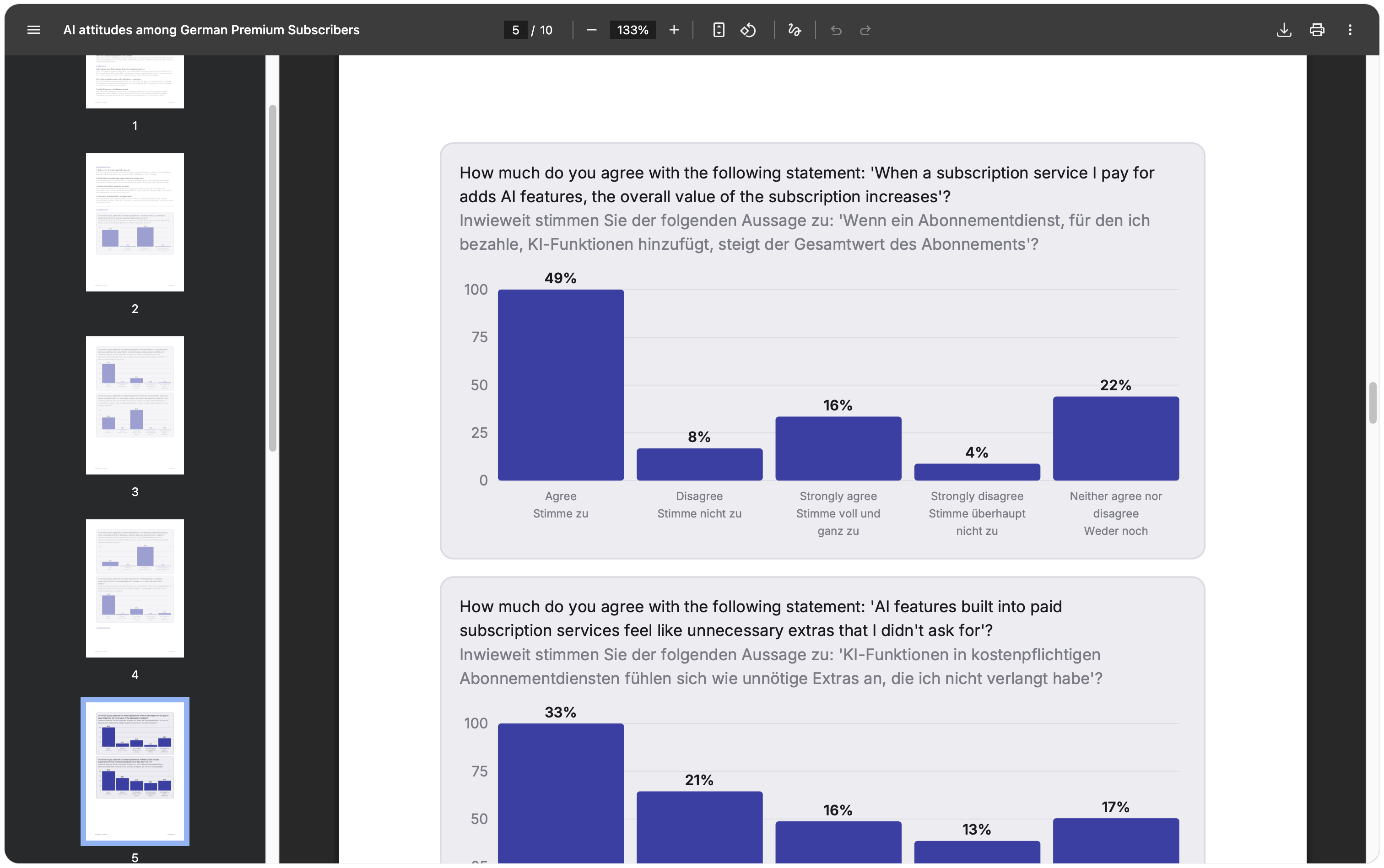
Each chart is headed by the question in the language it was asked in, with the English underneath, and the bars carry the original answer options. Hover a bar for its English label.
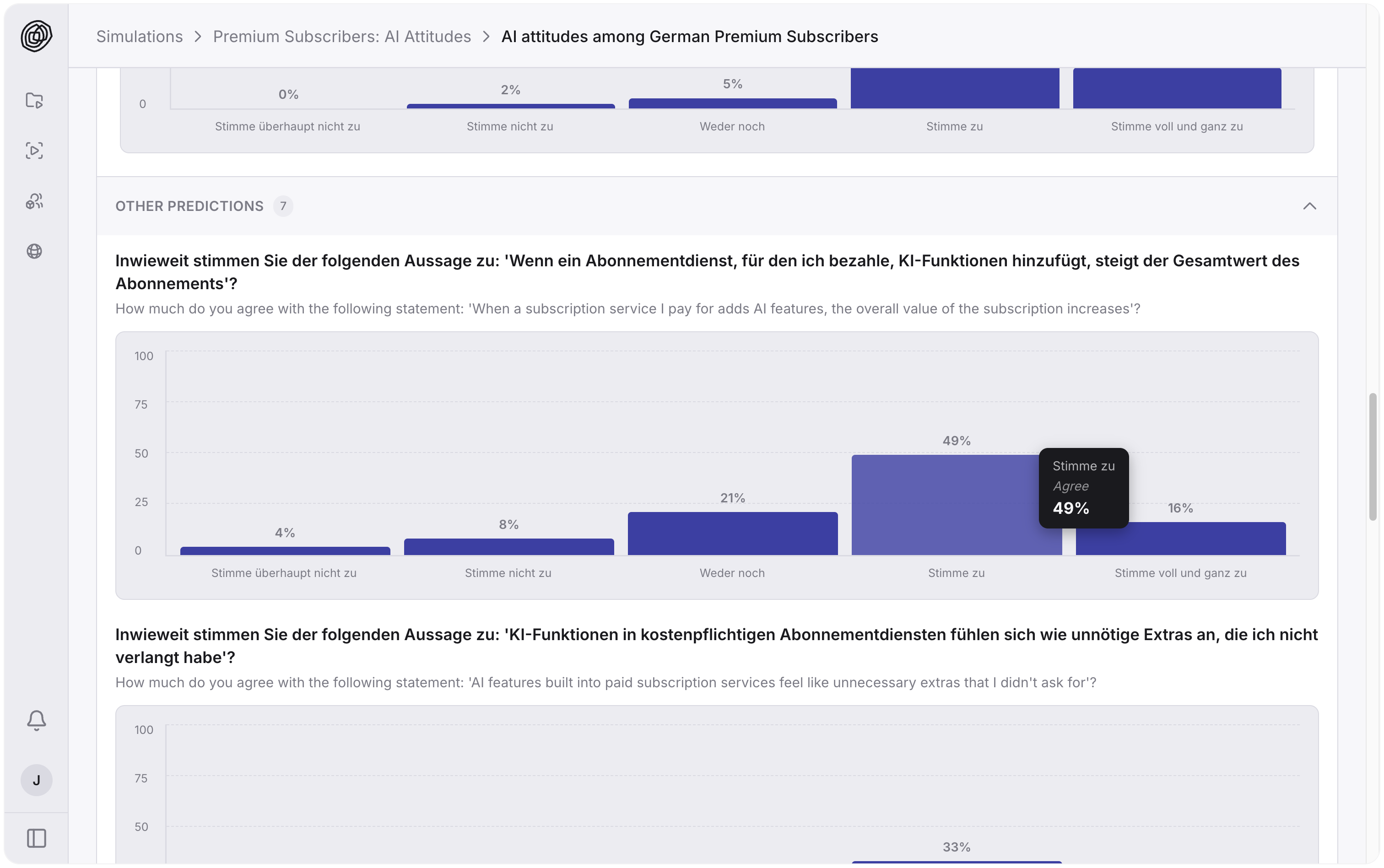
The write-up across a set of simulations is in English. Where the exact wording is the finding, it quotes the original in brackets, so a recommendation about the copy on a page can tell you which of "simuliert" and "vorhergesagt" German respondents preferred, when both translate into English as the same word. That distinction doesn't survive translation, so we don't translate it away.
Watch them use your product in their language
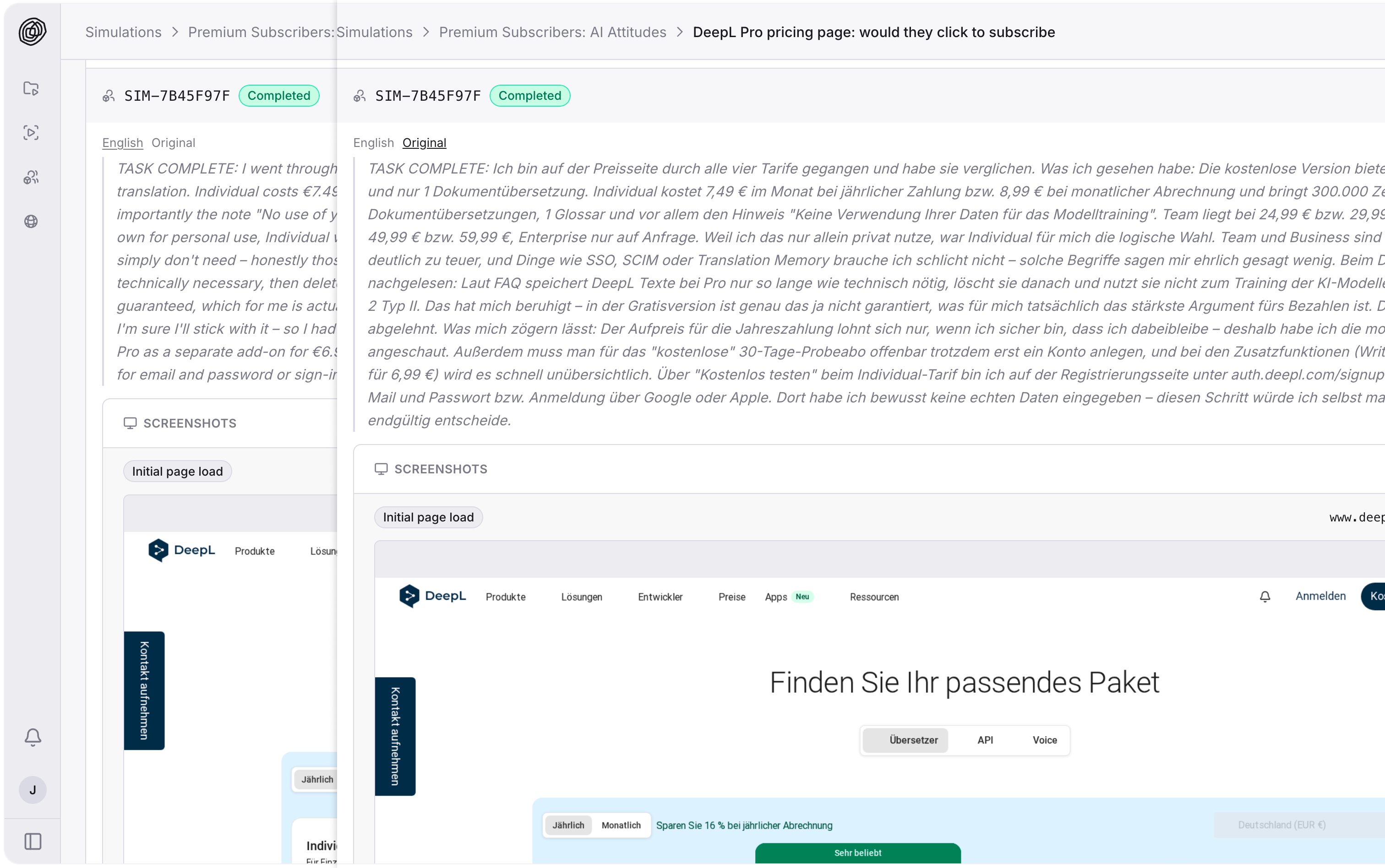
You can also put a non-English model through an interface and watch what it does. The task and the follow-up question are written in your users' language, the way a native speaker would phrase them, and your simulated users read the screen, think, and write up what happened in that language.
The interface doesn't have to be in the same language. Point a model of Spanish speakers at your English site to find out how Spanish speakers get on with it.
Each simulated user's write-up is translated into English, with a toggle on every session to read the original.
The agent knows which language to plan in
In Projects, where an agent plans your simulations for you, it already knows which language each of your models speaks and writes the questions in that language and in English.
You direct it in English. Tell it to address German respondents as "du" rather than "Sie" and it rewrites the German questions, and the English stays as it was.
Export in English with the original alongside
PDF and Markdown reports give each question in English with the original under it, and each answer option in English with the original in brackets. Chart images put the original label under each English one, so a chart dropped into a deck still reads for someone who only has the English.
CSV comes as two downloads, one in English and one in the original language, because a spreadsheet is usually going somewhere that expects one or the other.
Every user model shows the language it speaks wherever you pick one, so you know which language a simulation will run in before you start it.
Get a model of your users in their language
Non-English models are available on Semilattice Custom, at the same price as an English one. If your users speak a language other than English, book a call and tell us which.